The Merchant Who Didn't Need a Backup Plan
Most e-commerce origin stories follow the same arc. Someone builds a store manually, the conversion rate disappoints, they switch to a better tool, and results improve. This story doesn't work that way.
Afnas, an India-based dropshipping creator, had used an AI-built Shopify store once before. He already knew what the output looked like, how it converted, and whether the content quality held up under real traffic. So when he identified his next product, he didn't experiment with manual builds or compare themes. He went directly to Forge AI and built from there.
He wasn't fixing a problem. He was starting from a position of confidence - and that confidence turned out to be extremely well-placed.
The Biggest Risk Nobody Talks About in Indian E-commerce
Before we get to conversion rates, it's worth understanding the business environment this merchant was operating in. Indian e-commerce has a problem that Western dropshipping case studies almost never address: RTO.
RTO stands for Return to Origin - when a customer places an order, the package ships, and then it comes back to the seller because the delivery was refused, the address was wrong, or the buyer changed their mind on a COD (Cash on Delivery) order. In the Indian market, RTO rates on COD stores can run anywhere from 30% to 60%. On thin dropshipping margins, that's a business-ending problem.
The standard playbook in Indian dropshipping is to offer COD to reduce checkout friction and accept the RTO hit. Most stores that do this see conversion rates under 2%, even at their best. Economics only works at scale - and most beginners don't have that scale.
This merchant made a deliberate decision to go prepaid-only. No COD. No return-to-origin risk. Lower volume of potential buyers, but a far cleaner business with better unit economics. For that strategy to work, the store itself needed to do a lot of trust-building work at the moment of decision.
The Build: Product to Launch
The merchant's process was intentionally lean. After identifying the product, he used Forge AI to generate the complete store - design, copy, hero imagery, and product pages - without starting from a blank theme or hiring a designer.
How this store went from product selection to launch:
- Product identified - Winning product selected for the Indian prepaid market.
- AI store generated - Full store built with Forge AI: hero banners, brand identity, product descriptions, and page layout all generated in one pass.
- Prepaid-only setup - COD intentionally disabled to eliminate RTO risk from day one.
- Launch - The store went live without additional design work or manual content creation.
- Minimal optimisation - Only a few post-launch tweaks were made. No major redesign or new copywriting.
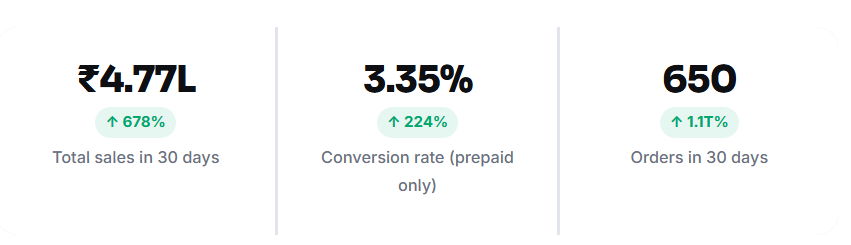
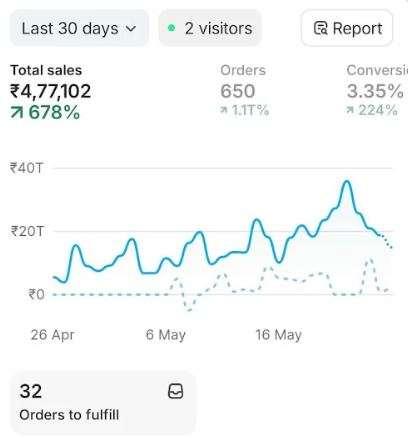
- Results - ₹4,77,102 in sales across 650 orders within 30 days.
One detail worth pausing on: only a few optimisations were made after launch. The store that converted at 3.35% is almost entirely the store that Forge AI generated from the initial input. Most case studies celebrate a result after weeks of iterative CRO, A/B testing, and agency-level refinement. This wasn't that.
Why Content and Creative Quality Matter More Than People Think
Afnas was explicit about one thing: the quality of AI-generated content was a non-negotiable requirement. Not just "good enough," but good enough to compete with professional store designs in a skeptical, price-sensitive market.
He evaluated Forge AI against other tools in the market before committing. His assessment was that the generation quality - both for written content and for imagery - was noticeably higher-end than the alternatives. That's one of the reasons he chose the tool for a second store.
This matters for prepaid conversion in particular. When a customer can't pay on delivery, the store is the only thing standing between uncertainty and purchase. Every element - from the hero image, the product description, and the layout, to the brand consistency - either reduces friction or adds it.
Customers paying upfront are making a trust decision, not just a purchase decision. Visual professionalism, brand coherence, and copy clarity are the conversion levers - not discounts or urgency timers. A store that looks like it was built in an afternoon reads that way to the buyer.
He also noted that despite the quality of output, the platform was navigable from the start, even for someone without design experience. Beginners didn't need to decode the interface. Advanced users didn't feel limited. That usability combination is rarer than it sounds.
The Numbers: What 3.35% Actually Means
Conversion rates are one of the most misread metrics in ecommerce. A 3% conversion rate on a COD store and a 3% conversion rate on a prepaid-only store are entirely different achievements.
| Store type | Typical conversion | RTO risk | Unit economics |
|---|---|---|---|
| COD store (Indian market) | Below 2% (best case) | High (30–60% RTO) | Thin, volume-dependent |
| Prepaid store (Indian market) | Below 1.5% (typical) | Near zero | Healthier per order |
| This store (prepaid only) | 3.35% | Near zero | ₹4.77L in 30 days |
Even COD stores in India rarely see a best-case conversion rate above 2%. This store, running prepaid-only - effectively removing the easiest checkout option available - hit 3.35%. That's not just a good number. In the context of the Indian prepaid dropshipping market, it's genuinely unusual.
The 678% increase in total sales compounds this picture. That metric reflects a comparison to a prior benchmark - a 678% jump in sales at a 3.35% conversion rate suggests significant traffic quality combined with a high-trust storefront. Traffic converts at that rate when the store earns it.
Why This Worked: The Real Explanation
Results this specific don't happen by accident. Here are the actual factors at play.
- Store quality removed the default objections. Prepaid buyers in India are trained to be skeptical. Low-quality store design, inconsistent imagery, and robotic product descriptions are all signals that a store might be a scam or an unreliable operation. A professionally built storefront signals the opposite, even when the merchant behind it is a solo creator.
- Confidence at launch accelerated the feedback loop. When a merchant launches with high confidence in their store's conversion potential, they behave differently. They invest in traffic sooner, they don't second-guess the store design mid-campaign, and they focus their energy on product selection and ad creative rather than rebuilding pages.
- Prepaid-only wasn't a limitation - it was a filter. By removing COD, this merchant filtered out low-intent buyers from the start. The customers who completed checkout were buyers, not browsers hedging their bets with a cash-on-delivery option.
- Minimal post-launch interference. Counterintuitively, one of the reasons the results look this clean is that the merchant didn't significantly change the store after launch. The AI-generated output did the work. There's no redesign moment to attribute the uptick to - the baseline conversion quality was embedded from the start.
Afnas' Own Words
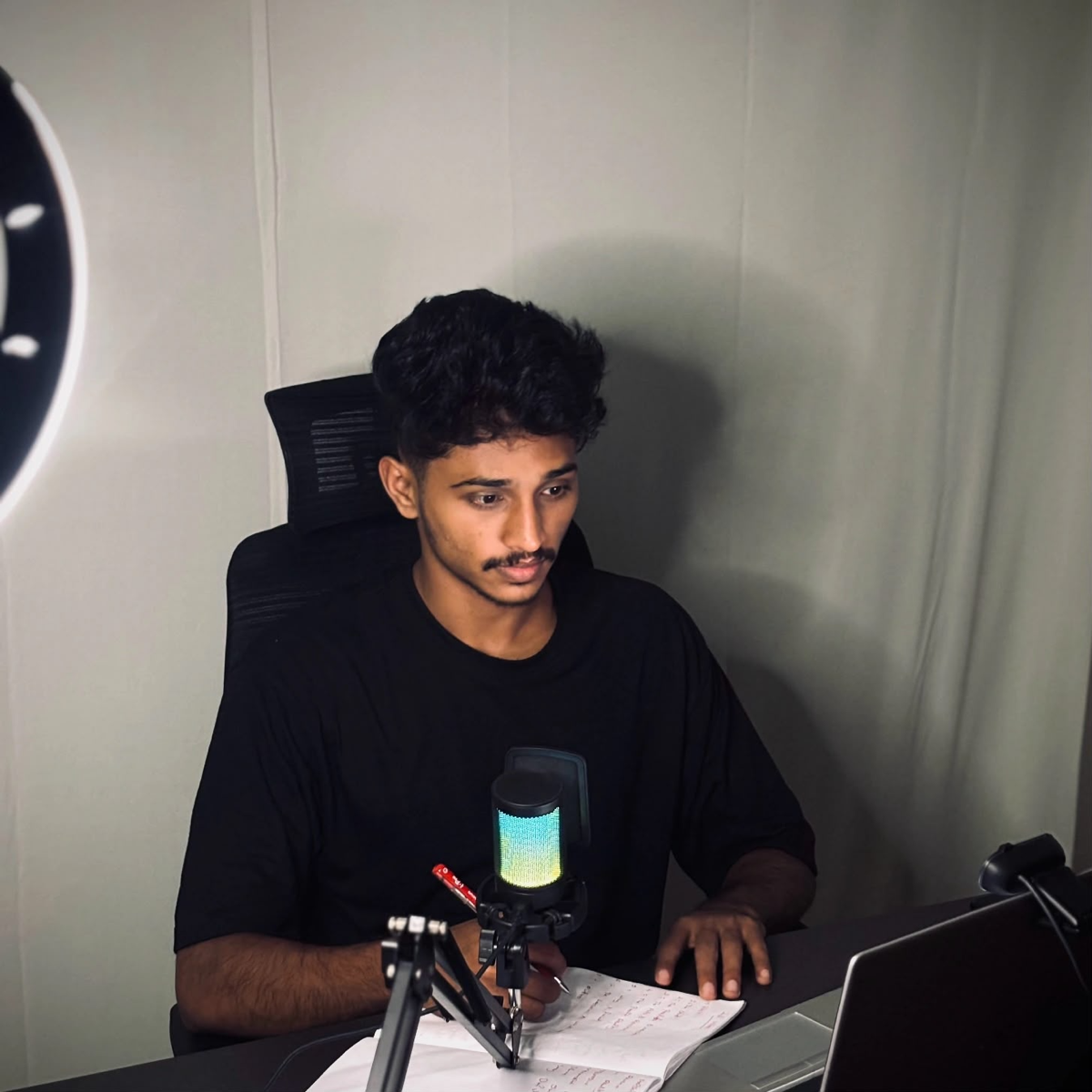
"Honestly, these results shocked me. ₹4.7L+ in 30 days with a 3.35% conversion rate in the Indian prepaid dropshipping market is insane. Forge AI doesn't just build stores - it builds stores that convert."- Afnas, India-based dropshipping creator · YouTube
A few things stand out in that quote. He says the results shocked him - and this came from someone who chose the platform because he already trusted it. The shock wasn't about whether it would work, but about how clearly it worked. He also frames Forge AI not as a store generator but as something that produces stores that convert. That's the output he cared about - not a store that looks good in screenshots, but a store that turns visitors into buyers.
Key Business Lessons From This Outcome
- Confidence before launch affects launch quality. Starting with a tool you already trust produces better decisions at every stage - from traffic spend to creative testing to how quickly you scale.
- Prepaid-only is a viable strategy in India when conversion quality is high. The received wisdom says you need COD to compete. This store proves that it's not universal. Store quality can compensate for checkout friction.
- AI-generated content doesn't mean lower quality. Afnas explicitly compared Forge's output to alternatives. In his assessment, the quality was higher - not comparable. That evaluation shaped his product strategy.
- RTO elimination changes the economics of the whole business. Removing COD reduces top-of-funnel volume but improves every downstream metric: fulfilment rate, return rate, customer lifetime value, and margin.
- Launch speed matters. The faster a merchant gets to real traffic data, the faster they learn. An AI-built store compresses weeks of pre-launch work into hours.
- Minimal optimization is a signal of baseline quality, not laziness. If a store converts at 3.35% without significant CRO work, the original build carries most of the value.
The Broader Picture for E-commerce Founders
Indian e-commerce is not a simple market to crack. RTO risk, COD dependency, and aggressive price sensitivity make it one of the harder environments for a new dropshipping store to gain traction - especially prepaid-only, and especially with minimal post-launch intervention.
What this case study demonstrates is that store quality is a genuine competitive lever in this market. Not just aesthetically, but functionally. A store that presents professionally, generates coherent brand imagery, and produces well-written product content does different work than one assembled manually in a few days.
The more interesting implication is about the relationship between launch confidence and launch outcomes. This merchant didn't need to iterate his way to a result. He started at a quality baseline that was high enough to convert at 3.35% on a prepaid store in a competitive market, with very few adjustments required after going live.
That's a fundamentally different model than the standard "test, fail, rebuild" loop that most ecommerce founders go through. Whether an AI Shopify store builder can reliably replicate that baseline is the question every dropshipper in this market should be asking themselves before their next launch.
How quickly could you launch a conversion-ready store?
This store went from product selection to live in a single session. The 3.35% conversion rate came with it - before any significant optimisation.
Start Building Now