Here's what happened, what the data showed, and what actually drove the results.
| Case study at a glance | |
|---|---|
| Product | 50,000,000+ STL 3D Models Mega Bundle |
| Product type | Digital product (3D printing STL files) |
| Price | $19.90 |
| Store platform | Shopify |
| Store builder | Forge AI |
| Ad creatives | 6 AI-generated UGC-style videos (via Lensia AI) |
| Ad platform | Facebook Ads (4 ad sets) |
| Day 1 sales | 4 orders · avg CPP ~$4–$5 |
| Day 2 sales | 8 orders · avg CPP ~$16.10 |
| Winning audiences | Broad · 3D Printing & Design |
| Cut audiences | Makers & DIY · Business Owners |
Can You Launch a Digital Product Business Entirely with AI?
Based on this experiment, the answer is yes. But the more interesting question isn't whether it's possible. It's how each stage of the workflow changes when AI handles the heavy lifting, and what the data looks like when you remove the traditional bottlenecks one by one.
This case study documents a real experiment. One creator. One digital product priced at $19.90. An AI-assisted workflow covering every stage from product validation through paid advertising. No design agency. No video production budget. No manual copywriting.
The product was a 50,000,000+ STL 3D Models Mega Bundle, a single digital download offering over 50 million 3D-printing-ready design files. On Day 1, it generated 4 sales at about a $4–$5 cost per purchase. On Day 2, 8 more, at about $16.10.
Here's the full breakdown of what happened, in the order it actually happened.
The AI Ecommerce Workflow: How the Pieces Fit Together
Before getting into specifics, it helps to see the complete picture. It was a connected workflow where AI handled a different bottleneck at each stage.
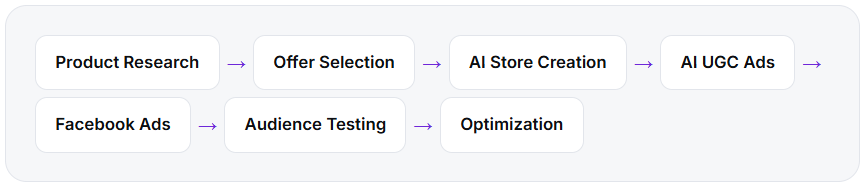
That workflow, research, build, create, test, optimize, is the actual throughline of this case study. Forge AI handled store creation. Lensia AI handled video ad production. Facebook Ad Library handled demand validation. Facebook Ads Manager handled traffic and performance data.
How to Find a Digital Product With Existing Demand
The most common mistake in digital product creation is skipping the demand validation step. Creators build a product first and then look for buyers. This experiment reversed that sequence entirely.
The research started in the Facebook Ad Library. This is a publicly available tool that shows active ads from any advertiser on the platform. The process was deliberate:
- Search for digital product advertisers.
- Study which products multiple advertisers are promoting simultaneously.
- Analyze the creative formats being used.
- Compare how different sellers position similar offers.
- Look for products appearing across more than one active campaign.
During this research, the 50M+ STL 3D Models Bundle kept appearing. Multiple sellers were actively advertising it. This was a demand signal strong enough to justify moving forward without starting from scratch.
The creator purchased the product with resale rights and moved directly to the next stage. The entire validation process from idea to decision happened in the research phase.
How to Build a Shopify Store With AI
With the product ready, the next step was building a store that could actually convert visitors into buyers. The creator's goal here was specific: not just a functional store, but a professional, focused one built around a single, clear offer.
Traditional Shopify store setup involves choosing a theme, writing product copy, creating or sourcing visuals, building the homepage layout, adding upsells, and optimizing for mobile, often across multiple sessions. For a $19.90 digital product, that level of investment doesn't make economic sense at the testing stage.
Forge AI handled the entire store generation in one workflow. The output was a complete, mobile-responsive storefront with layouts, product presentation, copy structure, and visual theme, all ready to receive paid traffic without further redesign.
What the AI-generated store included:
- Complete page layout
- Product-focused copy structure
- Mobile-optimised design
- Branded visual theme
- Clear purchase path
- Digital delivery setup
The store was built to answer one question quickly: what is this, how much does it cost, and why should I buy it now? Everything else was secondary.
The creator's own observation about this store was direct: "Sales started coming in from the very first day."
That's not attributable to traffic volume alone. A store that doesn't communicate its offer clearly loses buyers at the page level, regardless of how much is spent on ads. This one didn't.
Why a Simple Store Outperforms a Complicated One for Digital Products
This is worth spending a moment on, because it runs counter to how many first-time founders think about store design.
More design does not mean more conversion. For a single digital product at a low price point, the buyer's decision is fast. They're not researching for weeks. They see the offer, evaluate the value, and either buy or leave, usually in under 60 seconds. A complex store with multiple sections, heavy animations, and competing CTAs works against that process.
A focused product page that puts the offer front and center, communicates the value proposition clearly, and removes friction from the checkout path is almost always more effective for a product like this. That's exactly what the AI-generated store provided: structure that serves the buyer's decision rather than the seller's desire to showcase features.
The Facebook Ads Campaign: Four Audiences, Six Creatives
The campaign was structured around one principle: test multiple hypotheses simultaneously rather than betting everything on one audience assumption.
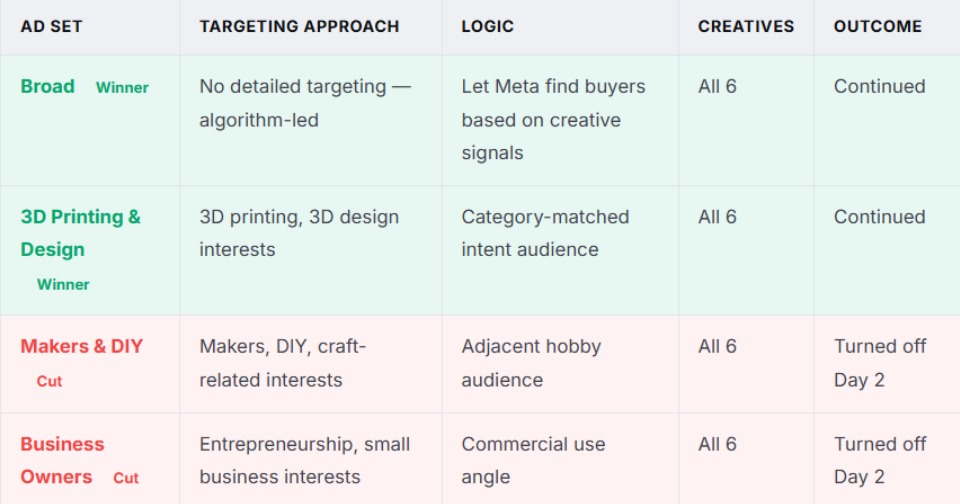
Running all 6 creatives across each ad set meant the algorithm had enough variation to find the best-performing combinations without manual guessing. This setup, multiple creatives per audience, broad test scope on Day 1, rapid elimination on Day 2, is a standard paid acquisition testing framework. The AI tools made it affordable to execute at this pace.
Day 1: What the First Sales Actually Showed
Day 1 produced 4 sales at an average cost per purchase of $4–$5.
| Day 1 | Day 2 | |
|---|---|---|
| Sales | 4 | 8 |
| Product price | $19.90 | $19.90 |
| Cost per purchase | ~$4–$5 average | ~$16.10 average |
| What the data showed | About $15 left per order after ads | About $3.80 left, then losers cut |
On a $19.90 order, a $4–$5 cost per purchase leaves about $15 per sale after ads, before payment fees. With no shipping and no inventory, that is a healthy margin, roughly 4x return on ad spend.
Day 2: Why the Cost Per Purchase Jumped and What the Data Revealed
Day 2 produced 8 sales, which is twice the first day's volume. The average cost per purchase jumped to about $16.10. Against a $19.90 order, that is still above break-even, but only just: about $3.80 left per sale before payment fees, versus about $15 on Day 1. The day did not lose money. It stopped being a margin worth scaling.
Two of the four ad sets, Makers & DIY and Business Owners, were spending budget without generating purchases. That inefficiency was dragging the campaign average upward. The winning audiences were still performing, but their results were being diluted by ad sets that simply hadn't found buying intent in their respective audience pools.
The response was straightforward: turn off the non-performing ad sets immediately. Not after another day. Not after adding more budget to see if they recover. Off, immediately, based on the data.
This is one of the most practical lessons in the entire experiment. Letting non-converting ad sets run because they might improve is one of the most common and most expensive mistakes in beginner Facebook Ads management. The data showed clearly which audiences were working. The right move was to concentrate on those.
Forge Didn't Just Build a Store. It Removed the Biggest Bottleneck
Most ecommerce founders spend a disproportionate amount of their launch energy on the store itself. Choosing a theme. Writing copy. Sourcing images. Testing the mobile layout. Configuring the checkout. Checking that the product page communicates the offer clearly. By the time the store is ready to receive traffic, days have passed, and the momentum that existed at the point of product discovery has often faded.
What Forge AI changed in this experiment was where that energy went. Because the store was ready quickly, the creator could move from product decision to live ad campaign in a single overnight session. The time that would have gone to store-building went to campaign structure, creative testing strategy, and audience selection instead.
That shift has a concrete effect on outcomes. A founder who spends three days building a store launches on Day 4 with a full budget but limited runway to optimize. A founder who launches on Day 1 with a conversion-ready store has three extra days of campaign data, which, in a test-and-iterate model, is the most valuable thing there is.
"The interesting part? Sales started coming in from the very first day. The store was simple, focused on the offer, and designed specifically around converting visitors into customers."- Ejas, creator of the 50M+ STL 3D Models experiment
That outcome of sales on Day 1, from cold traffic, on a brand-new store doesn't happen by accident. It reflects a store that was built with conversion in mind from the start, not retrofitted for conversion after the fact. That's the specific contribution Forge made to this workflow, and it's the one that made every other stage, the ads, the audiences, the optimization, worth running at all.
Why Store Quality Is the Hidden Variable in Digital Product Sales
When a digital product campaign underperforms, the instinct is almost always to blame the ad. Wrong audience. Wrong creative. Wrong budget. Those are real variables, and they matter, but they're also the variables most founders obsess over while leaving the store itself unexamined.
A digital product at $19.90 is an impulse-adjacent purchase. The buyer doesn't need weeks to decide. They arrive, they evaluate the offer in a few seconds, and they either convert or leave. That means the store's job is to make the value proposition obvious, the purchase path frictionless, and the brand presentation credible, all within the first few seconds of a visitor's attention.
Most manually assembled Shopify stores fail that test on Day 1. Not because the founder made bad design decisions, but because building a conversion-focused store from scratch, without a clear design brief, without professional copywriting, without tested layout patterns, is genuinely difficult to do quickly and do well.
In this experiment, Forge AI solved that specific problem. The store that went live on Day 1 wasn't a rough draft to be improved over time. It was a complete, professionally presented storefront that could hold up against cold traffic immediately. That's what allowed the broader AI workflow to function: product research, AI ad production, and Facebook campaign testing all depended on having a store worth sending traffic to. Forge provided that foundation.
For anyone building a digital product business where margins are high, delivery is instant, and the cost of a non-converting store is pure lost opportunity, the quality of the storefront at launch isn't a secondary concern. It's a primary one.
What Actually Made This Strategy Work
Demand validation came before product creation
The Facebook Ad Library step meant the product choice was informed by existing market behavior, not wishful thinking. Finding multiple independent advertisers promoting similar products is not a guarantee of profitability, but it's a meaningful prior. It shifts the odds.
Store quality matched the offer, not the ambition
A $19.90 digital product doesn't need a ten-section homepage. It needs one clear page that communicates the offer and makes checkout frictionless. The store was built to serve that purpose, and it did, from the first day of traffic.
Creative volume created testable data
Six creatives gave the algorithm something to work with. A single video ad tested across four audiences is a gamble. Six creatives is a structured experiment. The difference in what you learn, and how quickly, is significant.
The optimization decision was made on data, not intuition
Cutting Makers & DIY and Business Owners was the right call, but only because the Day 2 data made it clear. Gut instinct on Day 1 might have kept all four ad sets running "to give them more time." The willingness to cut quickly, based on evidence, is what separated the continuing campaign from one that would have spent its way into a worse average CPP.
Key Lessons From the Experiment
- Existing demand is a better starting point than a new idea. Finding a product already being advertised by multiple sellers dramatically reduces product-market fit risk at the validation stage.
- AI compresses the workflow. It doesn't replace the strategy. Store creation, ad production, and research all moved faster with AI. But the decisions, which product, which audiences, when to cut, still required judgment.
- Digital products change the economics of testing. No inventory, no shipping, no RTO risk. A $19.90 product at a $4–$5 cost per purchase keeps about $15 per order after ads. The same product at $16.10 is only barely above break-even. That gap is why cutting the losing ad sets mattered.
- Judge the daily average, not one order. A single early purchase can look far cheaper or far more expensive than the day as a whole. The Day 1 average of $4–$5 is the figure that describes the test.
- Creative volume beats creative perfection at the testing stage. Six imperfect videos tested simultaneously generate more actionable data than one polished video tested alone. The algorithm needs variation to find signal.
- Cut losing ad sets based on data, not timelines. Makers & DIY and Business Owners didn't need another week. The data on Day 2 was clear enough to act on. Waiting would have wasted budget and obscured the results from the winning sets.
Launch a store you can send traffic to the same day.
This store went from product decision to a live campaign overnight. The first sales came on Day 1.
Install Forge AI